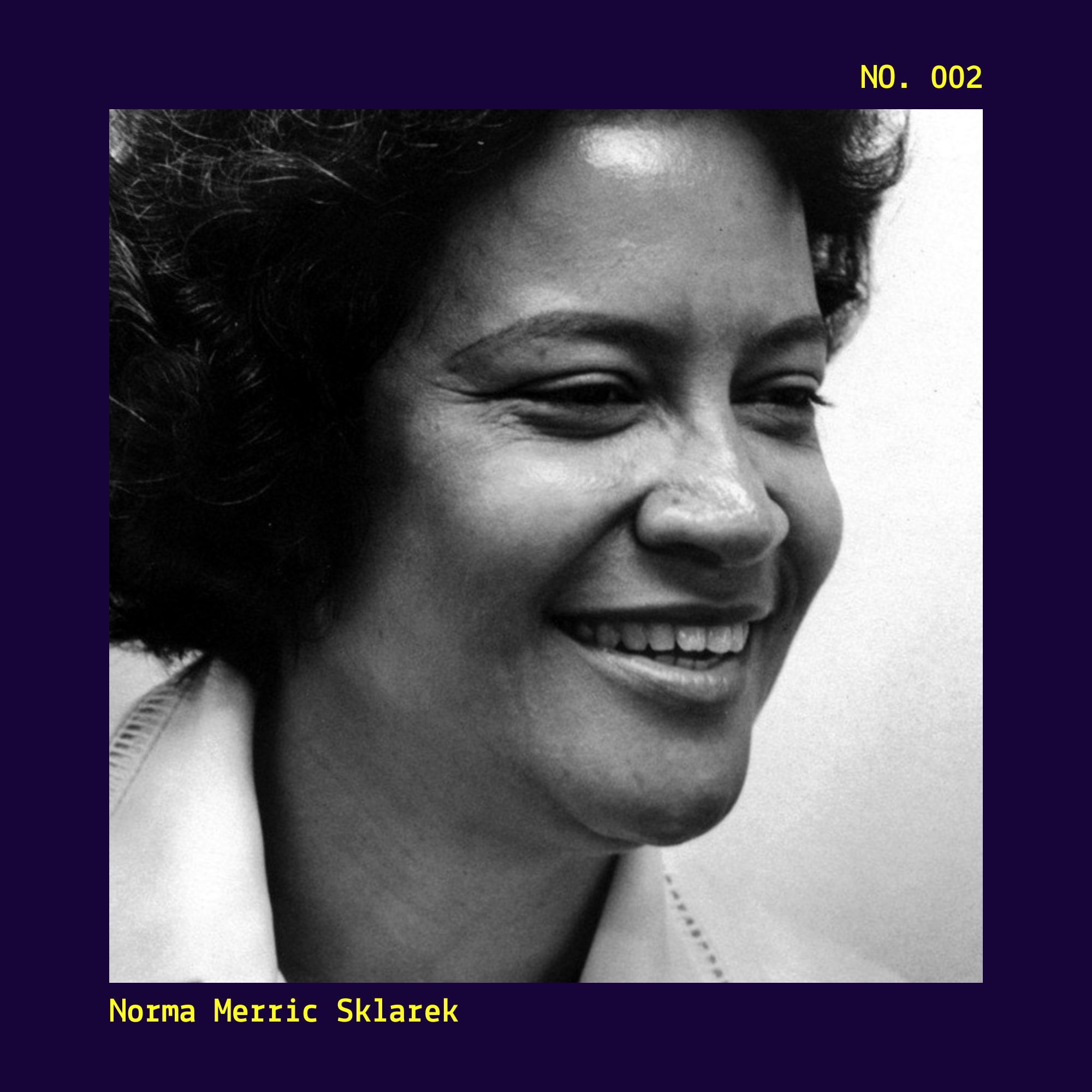
Norma Merrick Sklarek
MAJOR PROJECTS
1963 California Mart
1966 Fox Plaza
1970-1985 Park Center Commercial Complex
1972-1973 San Bernardino City Hall
1973 Commons Mall
1976 The U.S Embassy in Tokyo, Japan
1978 Pacific Design Center
1984 Terminal One at L.A. International Airport
1992 Mall of America
AWARDS & HONORS
1980 FAIA, first African American woman
1987 Outstanding Business Role Model Award
1998 Honorary member of Delta Sigma Theta
2007 Resolution from the California State Legislature honor
2008 AIA Whitney M. Young Jr. Award
Honored by the Black Women in Sisterhood for Action
CLUBS & MEMBERSHIPS
“Architecture should be working on improving the environment of people in their homes, in their places of work, and their places of recreation. It should be functional and pleasant, not just in the image of the ego of the architect.”
Norma Merrick Sklarek was a trailblazing architect, born on April 15, 1926, in Harlem, New York, to Trinidadian immigrant parents. As an only child, she grew up in a world where she was often one of the few who looked like her in predominantly white schools. But this did not deter her. Excelling in math, science, and fine art, Sklarek’s talents were apparent from an early age. Her father recognized her potential and suggested she pursue a career in architecture—a field where few women, let alone African American women, had ventured.
To prepare for this challenging path, Sklarek attended Barnard College, taking the necessary liberal arts courses to gain admission to Columbia University's prestigious architecture program. Reflecting on her collegiate experience, she once said, “The competition was keen. But I had a stick-to-it attitude and never gave up.” Her determination paid off. In 1950, Sklarek became one of only two women to graduate from Columbia’s architecture program and the sole African American in her class.
Despite her impressive credentials, Sklarek faced significant discrimination when seeking employment. The doors of opportunity did not open easily for her. She accepted a civil service job as a junior draftsperson with the City of New York’s Department of Public Works—a position far below her capabilities. Frustrated with the limited use of her talents, Sklarek decided to take the New York licensing exam in 1954. She passed on her first attempt, becoming the first African American woman licensed as an architect in the state of New York.
Sklarek’s persistence led to a breakthrough in 1955 when she was offered a position at Skidmore, Owings & Merrill. This prestigious firm provided her with more responsibility and the chance to work on larger-scale projects. To further share her knowledge, she taught architecture at the New York City Community College in the evenings, all while balancing her role as a single mother raising two children.
In 1959, Sklarek made history again by becoming the first African American woman admitted to the American Institute of Architects (AIA). The following year, she relocated to Los Angeles to work at Gruen Associates. Here, she encountered new challenges, including increased scrutiny from her supervisor due to her race and gender. One memorable incident involved her punctuality. Carpooling with a chronically late colleague, Sklarek was quickly reprimanded for tardiness—a situation her colleague had been allowed to get away with for years. Determined not to let this hinder her career, she bought her own car to ensure she could be on time.
Sklarek continued to break barriers, becoming the first African American woman licensed as an architect in California in 1962. At Gruen Associates, she rose to the position of Director of Architecture, overseeing significant projects such as the Pacific Design Center and the U.S. Embassy in Tokyo. Her son David once remarked that she excelled at making architectural plans tangible—deciding on the materials, nuts and bolts, and glass that brought buildings to life.
However, like many women in corporate architecture firms, Sklarek was often pigeonholed into the role of project manager rather than being recognized as a design architect. Despite being more than capable of leading large projects, it was rare for firms to present an African American woman as the face of their design efforts to clients. Undeterred, Sklarek continued to rise through the ranks, eventually joining Welton Becket Associates as vice president in 1980, where she oversaw the completion of Terminal One at Los Angeles International Airport (LAX).

Commons Mall, Columbus, Indiana 1973
Norma Sklarek, Gruen Associates
In 1985, Sklarek co-founded Siegel Sklarek Diamond, the first women-owned architectural firm in the United States, making her the first African American woman to co-own an architectural practice. Although the firm faced challenges in securing large projects, which led Sklarek to leave after four years, her pioneering spirit continued to inspire others.
Throughout the 1990s, Sklarek lectured at Howard University, Columbia University, and other institutions, mentoring young minority and women architects. Having had no mentor herself, she understood the importance of guiding the next generation. “In architecture, I had absolutely no role model. I’m happy today to be a role model for others who follow,” she said.
In 2003, Sklarek was appointed to the California Architects Board, where she served on several committees, including the Professional Qualifications Committee and the Regulatory Enforcement Committee. Her leadership extended to serving on various professional boards and committees, including the California State Board of Architectural Examiners, the AIA National Ethics Council, and the National Council of Architecture Registration Boards (NCARB).
Sklarek’s contributions to architecture were recognized in 2008 when the AIA honored her with the Whitney M. Young Jr. Award, which acknowledges architects or organizations that address social issues through their work. In her honor, Howard University established the Norma Merrick Sklarek Architect Scholarship Award, ensuring her legacy continues to inspire future generations.
Norma Merrick Sklarek passed away on February 6, 2012, at the age of 85, leaving behind a trail of accomplishments that paved the way for countless others in the field of architecture.